
The Mountains Biome Blog
Ideas, information, issues, and alerts from the IUCN-WCPA Mountains Biome
UPDATE: Wild Horse Impacts to Australian Mountain Animals--Part Three
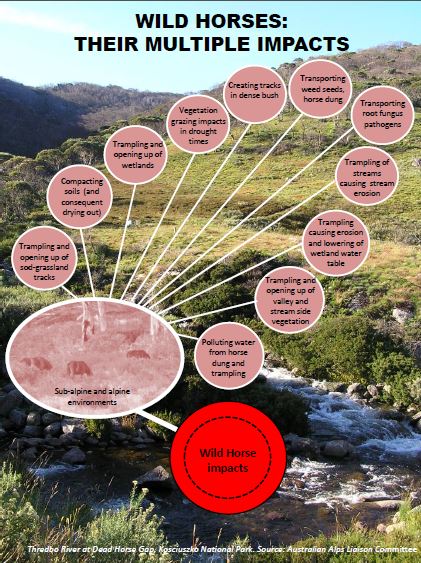
This Part Three document focuses on water availability and the impacts of wild horses on other Australian mountain animals in the Australian Alps catchments. Dr. Graeme Worboys states that this document is being sent to the four Australian Environment Ministers.
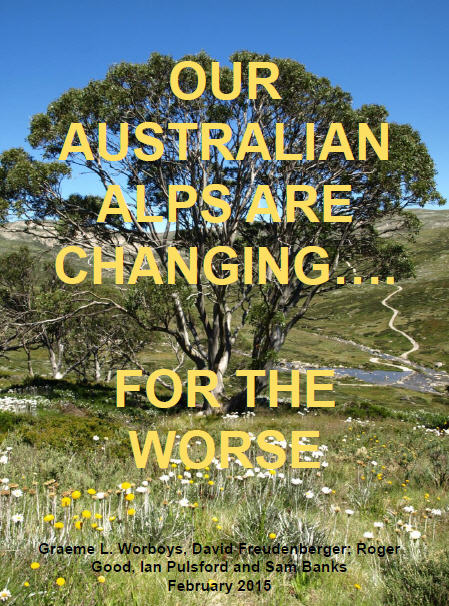
OUR AUSTRALIAN ALPS ARE CHANGING: ….. FOR THE WORSE
PART THREE WATER CATCHMENTS
WILD HORSE IMPACTS
Wild Horse Impacts to Australian Mountain Animals--Part Two
 Dr. Graeme L. Worboys has kindly shared this August 2015 report he prepared as a second part of his statement on Our Australian Alps are Changing--For the Worse:
Part Two: Wild Horse Impacts To Our Australian Mountain Animals
The “Australian Alps are Changing" …. Part Two: Impacts to our Australian Mountain Animals” statement is based on peer reviewed published literature, advice from many experts and the expertise, experience, active field research and observations of the author in the Australian Alps protected areas that spans a period of 42 years. The document is a private statement and responsibility for it rests with the author.
© This statement is available for general use, copying and circulation.
__________________________________________________________________________________
Citation: Worboys, G.L., (2015) Our Australian Alps Are Changing….For The Worse: Part Two, Impacts to our Australian Mountain Animals”, Canberra, Available at: www.mountains-wcpa.org
Acknowledgements: Appreciation is expressed to Sam Banks , Karl Bossard, Ken Green, Geoff Hope, Ian Pulsford and Chloe Sato for their inputs to and review of this statement.
Figures: The Australian Alps maps were prepared by Karl Bossard. Species location data for the maps was sourced from publicly available “Atlas of Living Australia” data.
Photo credits: Photographs presented in this statement were provided by Graeme L. Worboys unless otherwise identified.
Cover photo: The Mountain Pygmy Possum (Burramys parvus) in the hand of a zoologist/ researcher, Australian Alps national parks. Source: Australian Alps Liaison Committee
VACANCIES IN 2016 CALL FOR EXPRESSIONS OF INTEREST
2016 VACANCIES - CONNECTIVITY CONSERVATION AND MOUNTAINS EXECUTIVE
CALL FOR EXPRESSIONS OF INTEREST
Here is a downloadable invitation to participate in the WCPA CC&M Executive.
We encourage you to read the attached invitation and if you are interested, to submit an Expressions of Interest
--Graeme Worboys and Larry Hamilton
Due to the retirement of WCPA Co-Vice Chair (CC&M) Graeme Worboys and Senior Adviser, Editor, Larry Hamilton at the Hawaii World Conservation Congress in September 2016, two vacancies will exist in the WCPA CC&M Executive.
This note is a call for expressions of interest for anyone who may be interested in taking on one of these important and stimulating global stewardship roles. The intent is to appoint two replacements during 2015 to ensure that there is overlap between the current incumbents and the new appointees to help achieve a smooth transition for the CC&M Executive.
NEW REPORT - Pest Horse Impacts in Australian Alps National Parks
 Linda McMillan
in horse pest impacts Australia
|
Comments Off
Linda McMillan
in horse pest impacts Australia
|
Comments Off
;)
;)
Horses are an introduced animal in Australia. Many have gone wild in Australia’s mountain national parks and have bred up into such numbers that they are impacting the mountain catchments and subalpine native animals and plants. These are the natural values for which the national parks has been established.
;)
;) A new “observations” report has been prepared by our Mountains members Graeme Worboys and Ian Pulsford that clearly illustrates the extent of the damage to these nationally significant national parks. The report concludes that urgent and effective action is needed to end for ever these pest horse impacts; to restore the damage to the water catchments and to help conserve Australia’s native species.
A new “observations” report has been prepared by our Mountains members Graeme Worboys and Ian Pulsford that clearly illustrates the extent of the damage to these nationally significant national parks. The report concludes that urgent and effective action is needed to end for ever these pest horse impacts; to restore the damage to the water catchments and to help conserve Australia’s native species.
For further information: Press Release
Linda McMillan
UPDATE ON HORSE IMPACTS -
February 2015
Dr. Graeme Worboys has forwarded new information on the issue of the impacts of introduced horses in the Australian Alps:
Introduced horses - Ecological Change Agent Statement-2015
This statement is a private production. Its primary target is the “Independent Technical Reference Group, KNP Wild Horse Plan Review”. It is also being sent to each of the Environment Ministers responsible for the Alps and it is being made available publicly.
----------------------------------------------------------------------------------------------------------------------------------------
Cycling Silk moves on to Cyberspace

Cycling Silk was a 10-month, 10-country, 10,000-kilometer biking expedition along the Silk Road between Europe and Asia completed by Melissa Yule and Kate Harris. Their goal was to explore borderland wildernesses along the way, using bikes as vehicles for adventure, research, and environmental advocacy.
 Click to show their route through Trans-Boundary Conservation Areas
Nik Lopoukhine sends an update about this incredible project "Cycling Silk" which the IUCN-WCPA Mountains and Connectivity Conservation group has promoted since its inception in 2006. The project was sponsored by The Wild Foundation and IUCN-WCPA, among other groups. It was the inspiration of two young women who wanted to find a way to effectively promote the value of trans-boundary protected areas and wildlife conservation.
A new video trailer now shows the immensity and beauty of that trip.
Please share this extraordinary story with your friends and contacts. We have been told that a book and longer videos about this project are in the planning stage. Congratulations again to Kate and Melissa!
Stay tuned for more information on their book and future movies that will keep promoting trans-boundary conservation for years to come...